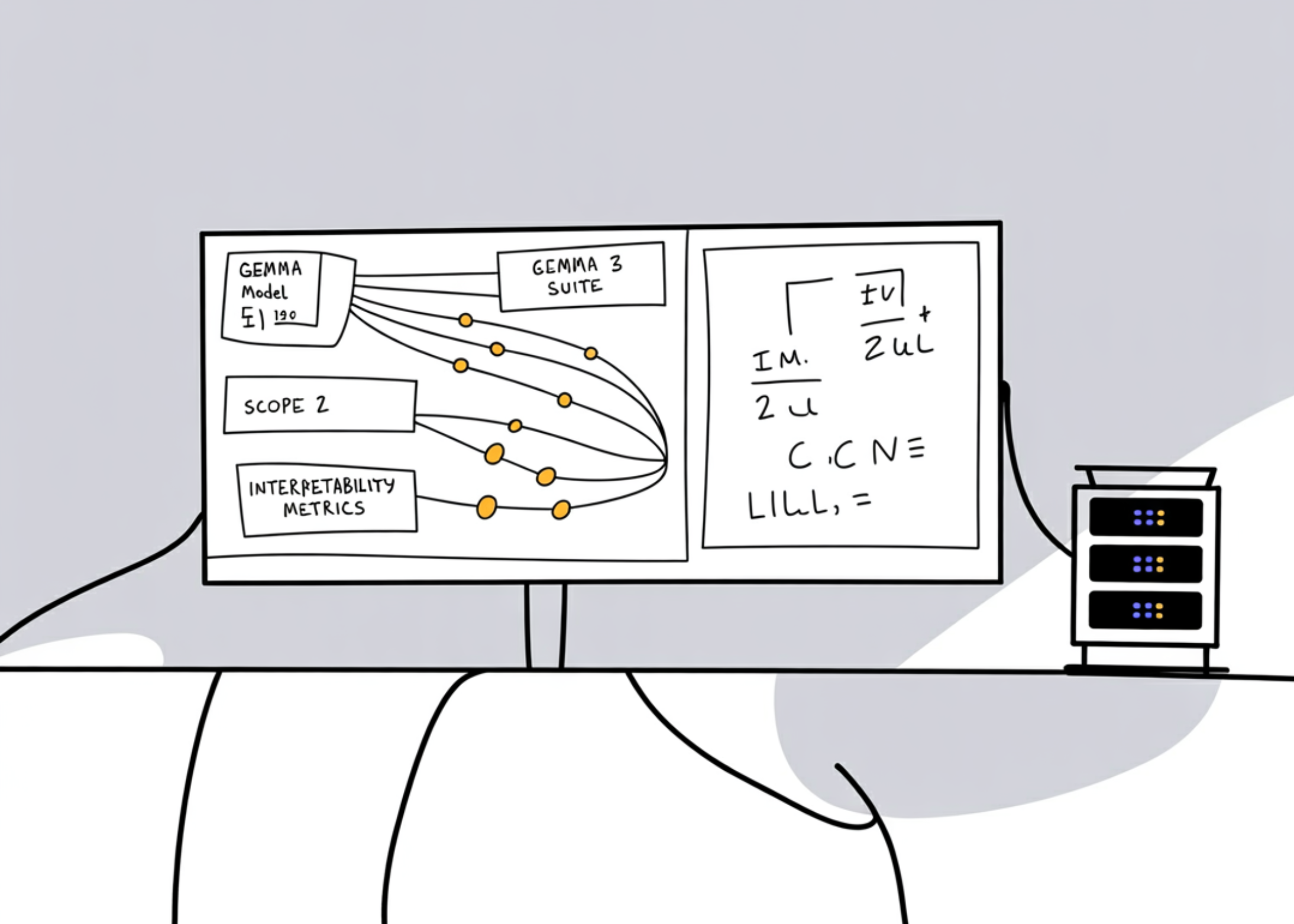
Google DeepMind Researchers introduce Gemma Scope 2, an open suite of interpretability tools that exposes how Gemma 3 language models process and represent information across all layers, from 270M to 27B parameters.
Its core goal is simple, give AI safety and alignment teams a practical way to trace model behavior back to internal features instead of relying only on input output analysis. When a Gemma 3 model jailbreaks, hallucinates or shows sycophantic behavior, Gemma Scope 2 lets researchers inspect which internal features fired and how those activations flowed through the network.
What is Gemma Scope 2?
Gemma Scope 2 is a comprehensive, open suite of sparse autoencoders and related tools trained on internal activations of the Gemma 3 model family. Sparse autoencoders, SAEs, act as a microscope on the model. They decompose high dimensional activations into a sparse set of human inspectable features that correspond to concepts or behaviors.
Training Gemma Scope 2 required storing around 110 Petabytes of activation data and fitting over 1 trillion total parameters across all interpretability models.

The suite targets every Gemma 3 variant, including 270M, 1B, 4B, 12B and 27B parameter models, and covers the full depth of the network. This is important because many safety relevant behaviors only appear at larger scales.
What is new compared to the original Gemma Scope?
The first Gemma Scope release focused on Gemma 2 and already enabled research on model hallucination, identifying secrets known by a model and training safer models.
Gemma Scope 2 extends that work in four main ways:
Key Takeaways
Check out the Paper, Technical details and Model Weights. Also, feel free to follow us on Twitter and don’t forget to join our 100k+ ML SubReddit and Subscribe to our Newsletter. Wait! are you on telegram? now you can join us on telegram as well.
Michal Sutter is a data science professional with a Master of Science in Data Science from the University of Padova. With a solid foundation in statistical analysis, machine learning, and data engineering, Michal excels at transforming complex datasets into actionable insights.