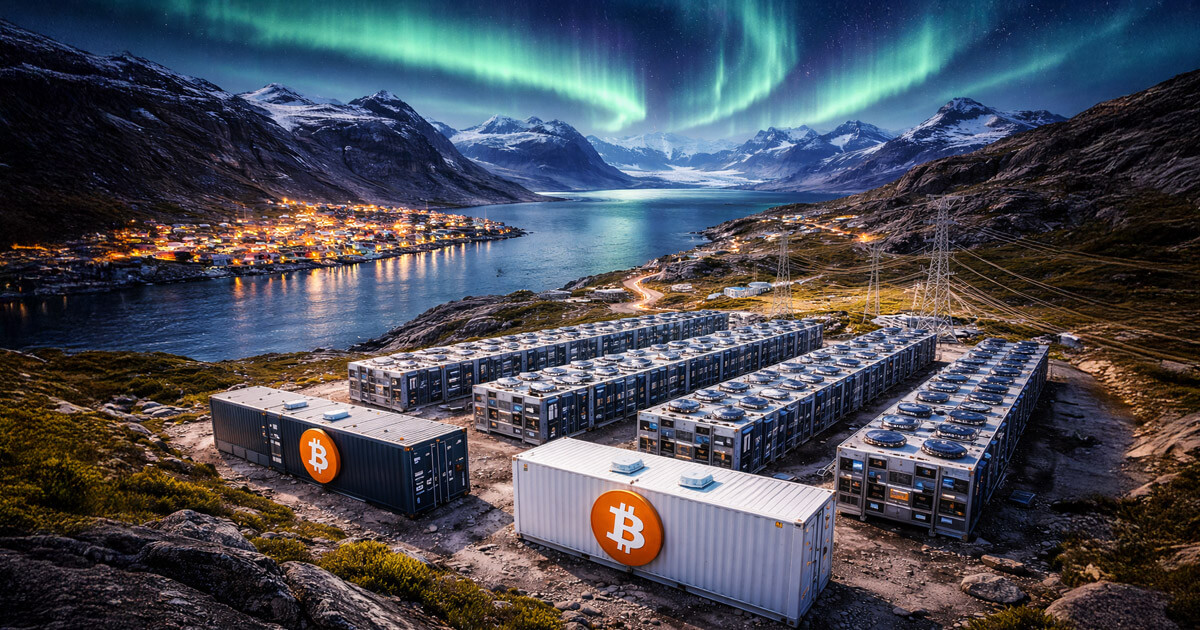
Talk of the United States buying Greenland has returned to Washington, and miners are tracking the power projects on the island.
The White House said a U.S. purchase of Greenland is an “active discussion,” according to Reuters.
For Bitcoin miners, the more actionable clock is Greenland’s industrial power planning.
How Greenland’s hydropower translates into real Bitcoin mining capacity
Greenland’s government said it plans to open a public tender round in the second half of 2026 for the two largest mapped hydropower sites intended for industrial use, Tasersiaq (site 07.e) and Tarsartuup Tasersua (site 06.g), according to Naalakkersuisut.gl.

It said the two sites together could produce more than 9,500 gigawatt-hours annually.
Mining math is straightforward.
Bitmain’s Antminer S21 specification lists 200 TH/s at 3,500 watts, or about 17.5 joules per terahash, according to Bitmain.
Using a planning power usage effectiveness value near 1.1 (cooling and overhead), 1 megawatt of facility power equates to about 0.052 exahash per second (EH/s) at 17.5 J/TH.
That implies about 0.041–0.061 EH/s across a 15–22 J/TH efficiency band.
Facility power (MW)Hashrate ceiling (EH/s) @ 17.5 J/TH, PUE 1.150.26251.30502.601005.19
Greenland’s installed base is far smaller than the tendered ambition.
Nukissiorfiit reports about 91.3 megawatts of hydropower capacity across its systems and an average electricity sales price of about DKK 1.81 per kilowatt-hour in 2024, according to its annual report.
Retail-style pricing at that level does not map cleanly onto mining economics.
That is why any large build depends on industrial power purchase agreements or behind-the-meter supply at new generation, rather than buying power like a normal customer.
The lack of a national grid narrows the paths to scale.
Power stations generally serve towns and settlements as local systems, with limited interconnection, according to Trap Greenland.
That pushes early “stranded” or surplus-energy concepts toward colocating flexible load at specific plants.
Greenland reporting has discussed utilizing surplus energy in the context of lowering energy costs, according to Greenland Review.
If 5–25 megawatts can be aggregated behind the meter near existing generation, the ceiling is about 0.21–1.52 EH/s across the 15–22 J/TH band (about 0.26–1.30 EH/s at 17.5 J/TH).
That is enough for pilots, but not enough to move global network share.
The next rung up is Nuuk’s main hydro plant.
Scaling bitcoin mining in Greenland: from surplus power pilots to grid-level expansion
Buksefjord is planned to expand from 45 megawatts to 121 megawatts, with construction expected to begin in 2026 and commissioning targeted for 2032, according to NunaGreen.
The European Investment Bank’s project pipeline references a roughly 76-megawatt Buksefjord-3 build near the existing 45-megawatt plant.
If 50–121 megawatts of output were contracted to miners, the electrical ceiling is about 2.07–7.33 EH/s across the 15–22 J/TH band (about 2.6–6.3 EH/s at 17.5 J/TH).
That assumes those megawatts are not absorbed by Nuuk demand growth and electrification plans.
The two-site tender is where Greenland becomes a gigawatt-scale discussion.
More than 9,500 GWh a year equates to about 1.08 gigawatts of average power if fully utilized.
That implies an electricity-limited hashrate ceiling around 44.8–65.7 EH/s across the 15–22 J/TH band (about 56.0 EH/s at 17.5 J/TH).
Tracking sites place Bitcoin hashrate around 1.03–1.17 zetahash per second (ZH/s), and minerstat places difficulty near 148 trillion, according to minerstat.
On that baseline, a fully utilized 1.08 GW mine implies about 4–6% of today’s network hashrate, with the share shrinking if global hashrate expands.
Could Trump-linked capital eye Greenland’s energy surplus for Bitcoin mining expansion?
Trump-linked mining capital is already forming, which is why Greenland’s power calendar could draw attention inside the sector.

Hut 8 partnered with Eric Trump to launch American Bitcoin, combining Hut 8’s mining operations with an investor group that includes Donald Trump Jr., while Hut 8 retained an 80% stake.
American Bitcoin said installed hashrate expanded to about 24 EH/s and cited fleet efficiency around 16.4 J/TH as of Sept. 1, 2025, according to the company.

Using the same PUE 1.1 planning value, 24 EH/s implies roughly 430 megawatts of facility power at 16.4 J/TH (about 460 megawatts at 17.5 J/TH).
That means a fully utilized 1.08 GW tender buildout could power an American Bitcoin-sized fleet more than once over, if the offtake were dedicated to mining and if transmission and construction timelines cleared.
Even in a “what if” sovereignty scenario, the constraints stay practical.
Industrial hydro requires multiyear construction, heavy logistics, and long-duration offtake, and mines need resilient data links, spares, and import capacity for ASIC fleets.
Greenland Connect links Canada, Nuuk, Qaqortoq, and Iceland by subsea cable, according to Tusass, but it does not solve transmission to remote hydro basins.
Clean, firm megawatts also face competition from other loads.
The International Energy Agency has warned that AI will drive higher electricity demand from data centers, which can raise the opportunity cost of dedicating long-duration renewable output to mining.
Diplomacy will shape financing conditions around any “Trump Greenland mine” thesis.
European officials have stressed that Greenland’s status rests on consent and sovereignty norms, according to Reuters.
Greenland’s tender round planned for the second half of 2026 will set the baseline for any large-scale Bitcoin mining offtake from new hydropower on the island.
Why Greenland’s energy economics and geopolitics matter for large-scale Bitcoin mining
However, if Greenland were brought under U.S. jurisdiction and treated as an energy buildout zone rather than a small, fragmented utility market, the renewable ceiling that matters for mining would shift from 1-GW-class hydro tenders to also focus on wind.
According to a systems study published in Energy and indexed on ScienceDirect, Greenland’s onshore wind technical potential is about 333 GW nameplate, producing about 1,487 TWh per year under the assumption that 20% of Greenland’s ice-free area is available.
That equates to about 170 GW of average generation on an energy basis.
Output would be variable and would require transmission, overbuild, curtailment, storage, and firming to serve a 24/7 load at scale.
Translating that energy-only ceiling into hashrate shows how far the “Trump Greenland mine” narrative can be pushed in theory.
At 15–22 J/TH with PUE around 1.1, 170 GW of average generation implies roughly 7.0–10.4 ZH/s of hashing capacity if miners could absorb the average output as a flexible load, well above today’s network.
Current hashrate stands at around 1 ZH/s, so acquiring enough mining machines to facilitate such a build-out makes this mostly a theoretical exercise in potential forward-facing limits.
Also, 10 ZH/s is not a “24/7 firm baseload” unless you add massive transmission, overbuild, curtailment, and storage/firming (or accept downtime/variable operation). It’s a ceiling based on absorbing average wind energy rather than delivering guaranteed power every hour.
Still, a crude linear extrapolation of that same study’s land-availability assumption from 20% to 100% implies about 7,435 TWh per year (about 848 GW average), or roughly 34.8–51.7 ZH/s.
That is a physics-and-maps ceiling rather than a build plan, given siting, permitting, ports, roads, and HVDC requirements.
According to IRENA, the global average installed cost for new onshore wind in 2023 was about $1,154 per kW.
That puts 333 GW at roughly $384 billion in turbines alone before Arctic premiums, transmission, and firming infrastructure.
OneMiners lists an Antminer S21 XP Hyd at 473 TH/s for $6,799. To utilize 333 GW, you’d need roughly 21,141,650 miners, which comes to around $143 billion.
However, that’s just the ASIC purchase cost. It excludes shipping, duties/VAT, spares, racks/PSUs/networking, buildings, cooling/hydro loops, and commissioning, stuff that’s very non-trivial at tens of millions of units.
All in, assuming hardware is available (which it isn’t), an investment of around $427 billion would give a miner based in Greenland enough renewable energy-sourced hash power to control the $1.8 trillion Bitcoin network ten times over. Or around $55 billion to equal the current network hashrate (it’s not simply 1/10th due to scaling).
These are all “back of an envelope” figures with lots of caveats and assumptions, but the reality is that there’s enough unused energy in Greenland to power the Bitcoin network many times over. With Starlink deployment, you could probably build some major AI datacenters, too.